
(only have a minute? jump to final thoughts)
For a lot of us, just the mention of “corporate social responsibility” can be enough to prompt an eye roll. But The Kroger Company’s Zero Hunger, Zero Waste program hits all the right notes.
The initiative treats tackling food insecurity and minimizing food waste as two sides of the same coin. The concept is simple, but the execution is more complex – requiring constant coordination and participation to get unsold food where it’s needed most before it goes bad.
Phase 1: Food rescue
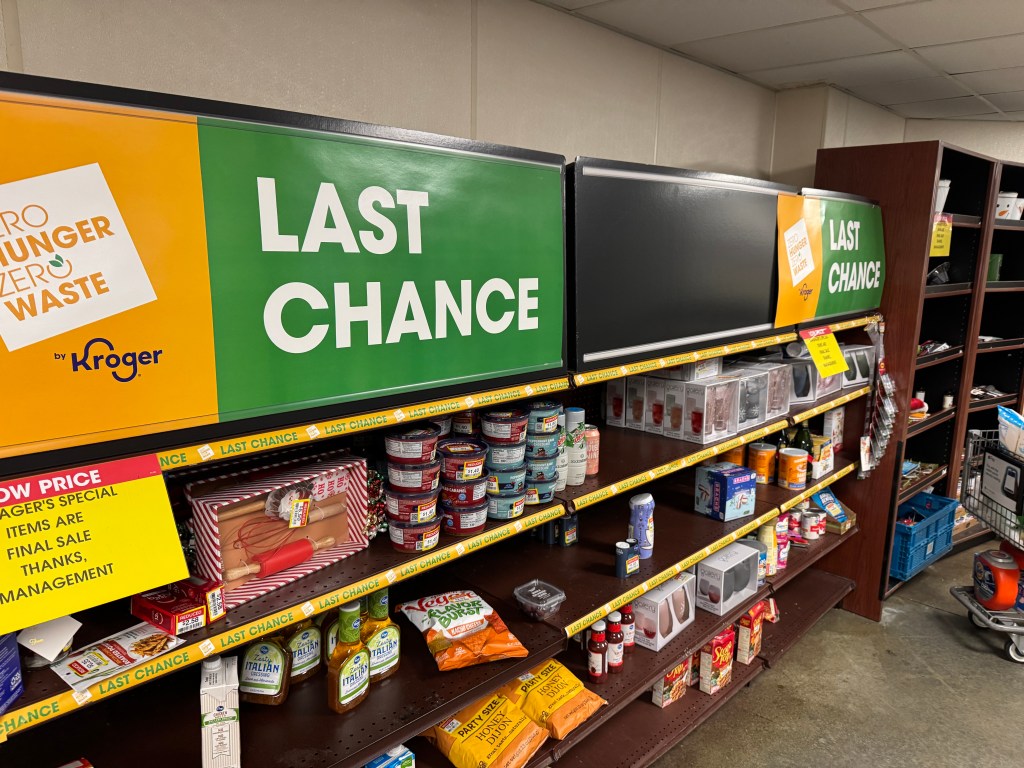
The first step in keeping food from being wasted (and thus out of the landfill) is a markdown program. Kroger stores keep special shelves in each department with reduced-price items that are approaching their sell-by date. That means bakery items, meat, dairy and more will find a home before they’re thrown out and possibly help reduce grocery costs for lower income shoppers.


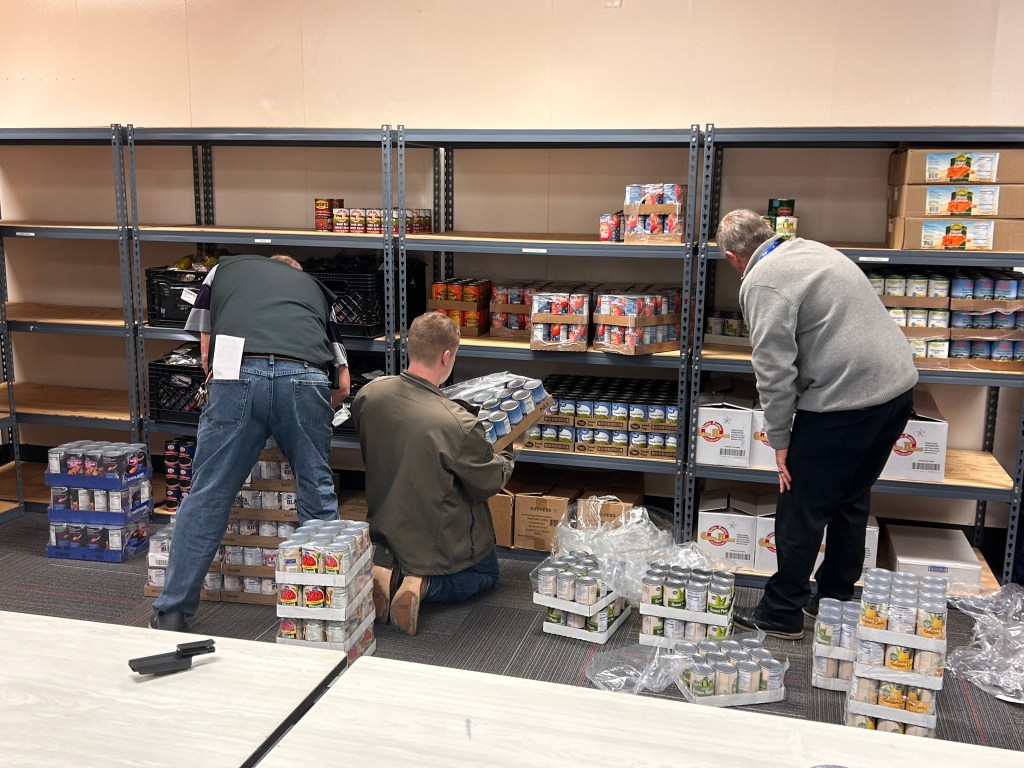


KROGER VOLUNTEERS AND COMMUNITY PARTNERS STOCK ATLANTA AREA FOOD PANTRIES
If the markdowns aren’t sold…
Unsold items that are still fit for consumption are donated to local food banks. Kroger regional rep Tammie Young-Ennaemba says it just makes sense for Kroger to ensure that food makes its way to people who need it.
“…38% of all the food that’s produced is thrown away, that’s about 230 million tons of food that is not sold or not eaten, and it’s just gone,” says Young-Ennaemba. “But you still have one in eight people that are food insecure. So being in the food industry, that’s why we would want to step in and make a change and make a difference.”
The logistics
Local organizations serve as the arms and legs of the “Zero Hunger” part of this operation. Churches and other nonprofits make regular trips to Kroger locations to pick up the donated groceries and bring them to area food banks. Young-Ennaemba says those local groups are the most knowledgeable about the needs of the communities they serve anyway, so the arrangement works well. She also points out that freezing things like meat and bread can extend its usefulness even further, buying enough time to transport it to a home in need.
Last stop: Compost
It’s not ideal, but not every perishable grocery item can be salvaged and eaten before it’s too far gone. For inedible produce, Kroger employs composting, which is outsourced and managed across all stores. The organic waste is then repurposed as energy or fertilizer.
It takes a village
Employees are a major part of the success of the Zero Hunger, Zero Waste program, and their participation is entirely voluntary. They work with various charitable entities like MUST Ministries and Hosea Helps. says it’s never a problem finding enough volunteers from within the company.
“We have a sign up process inside of our stores. Our associates look at it, they say, oh, I want to do this, I want to do that one. They sign up and then we gather together at the location and then we serve.”
Customers pitch in too. Kroger encourages customer participation through a round-up program at checkout, where funds are directed to the Zero Hunger, Zero Waste Foundation.
The impact
All of this effort pays off… Initially aiming to provide 3 billion meals by 2025, Kroger has exceeded this goal and is now working towards 10 billion meals (calculated by the number of pounds of food donated by the chain). In 2023, Kroger reported an 82% operational waste diversion from landfills company-wide, and since 2017 the program has produced $1.5 billion in charitable giving to end hunger.
The vision
Kroger sees itself as just one player in a societal effort to end hunger and reduce landfill waste. “What we do in this Zero Hunger Zero Waste mission is not just our ownership or responsibility, it’s everyone’s ownership and responsibility,” Young-Ennaemba explains.
That’s become an integral part of the culture in Kroger’s stores, from the C-suites to the checkout lanes, and it shines through, even to the company’s most conscientious shoppers.
Final thoughts:
The Kroger Company’s Zero Hunger, Zero Waste initiative serves as an example of how effective and powerful Corporate Social Responsibility programs can be. 100% of Kroger’s 2,700+ locations participate, giving the program a wide reach. The company’s leaders say with strong support from the communities they serve, it is successfully reaching its dual goals of eliminating hunger while significantly reducing food waste.
- Kroger uses several different avenues to reach its goals: in-store markdowns, food donations and composting
- Feeding America is a crucial partner in the distribution of excess groceries to food pantries
- Local philanthropic and faith-based groups provide support in pickup and distribution of food donations
- The initial goal of the program was to provide 3 billion meals by 2025. Kroger has exceeded this goal and is now working towards 10 billion meals
- Kroger encourages customer participation through a round-up program at checkout, where funds are directed to the Zero Hunger, Zero Waste Foundation
- Employees actively volunteer in food distribution and support initiatives
 the green gals podcast
Leave a comment