
(only have a minute? jump to final thoughts)
Environmental responsibility isn’t always easily compatible with business. Restaurants – especially in cities with weaker environmental policies – often have to take on a hefty financial burden if they want to recycle their glass or compost their food scraps. But with determination and some smart strategies, a shining few manage to take the sustainable high road without sacrificing profit or prestige.

steve simon, partner and founder of fifth group restaurants
Back during the great recession of 2008, when Atlanta entrepreneur Steve Simon was invited to become a member of the Green Food Service alliance, he wasn’t sure it was the right fit. But in those uncertain times, he was craving something positive.
“We didn’t have a lot of things to be celebrating in business because business was really down. And this felt good,” he says.
Simon is the co-founder of Atlanta’s Fifth Group Restaurants, which started with local favorite South City Kitchen in 1993 and has now grown into a string of fine dining establishments.
He embraced going green immediately, incorporating sustainable practices like conserving water into his restaurants’ daily operations. And that came with an unexpected benefit: lower water bills in a city that has some of the highest water and sewer rates in the country.
Another change Fifth Group made was diverting as much organic waste from the trash as possible by installing compost bins at all of its locations. Unfortunately, commercial composting added a significant monthly bill. And as costs increase every year, the burden gets harder to ignore.


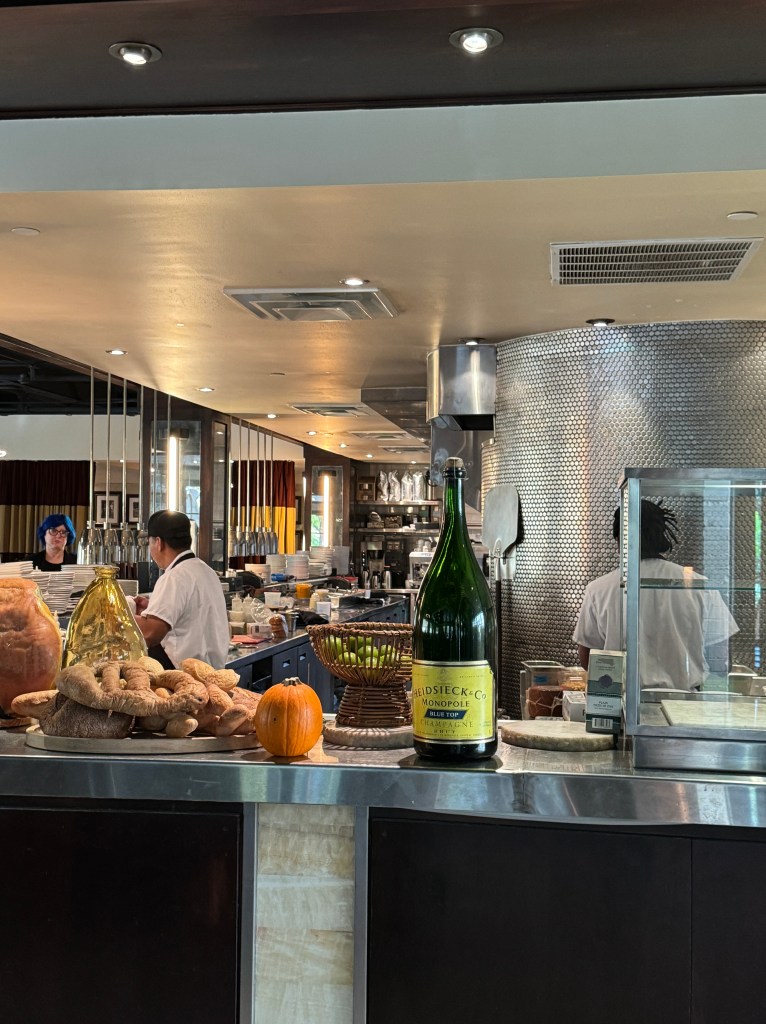
fifth group’s ecco in midtown atlanta
“As a company, we’re spending sixty or seventy thousand dollars a year. And in a year that things are down, sales are down, it’s a line item that we’re really scratching our head about. We’re not ready to give up on it yet. But it’s really frustrating,” Simon says.
It’s size of the impact that justifies the cost. Fifth Group’s 14 restaurants divert between 1,000 and 2,500 pounds of organic matter per month, per location. Few other businesses in this industry can boast such dedication to limiting food waste.
According to the National Restaurant Association, restaurants generate an estimated 22 to 33 billion pounds of food waste annually in the United States. So, restaurants are responsible for around a quarter of the country’s total food waste (133 billion pounds) – which, when dumped in a landfill, becomes a major methane emitter. And only 14% of restaurants compost their food waste. (To learn more about the impact of food waste, jump to Facts & Figures below.)

the chastain in atlanta, ga.
In north Atlanta’s affluent Buckhead area, The Chastain serves as a shining example for sustainable dining while serving up fresh dishes from its own garden.
The restaurant, which opened in November of 2020, takes the farm-to-table concept seriously, incorporating vegetables and herbs from its backyard in an ever-changing menu.
Executive Chef Christopher Grossman is also constantly in touch with around a dozen local farms to bring in locally grown food, which dramatically cuts the emissions it takes to gather all the ingredients the restaurant needs. Grossman says that’s a great side-effect, but it also serves his primary goal: to serve the freshest food possible.
“When you have food that has been harvested, cleaned, prepared, and never seen a refrigerator, that is not something that you can replicate as a chef. That level of freshness,” Grossman says.


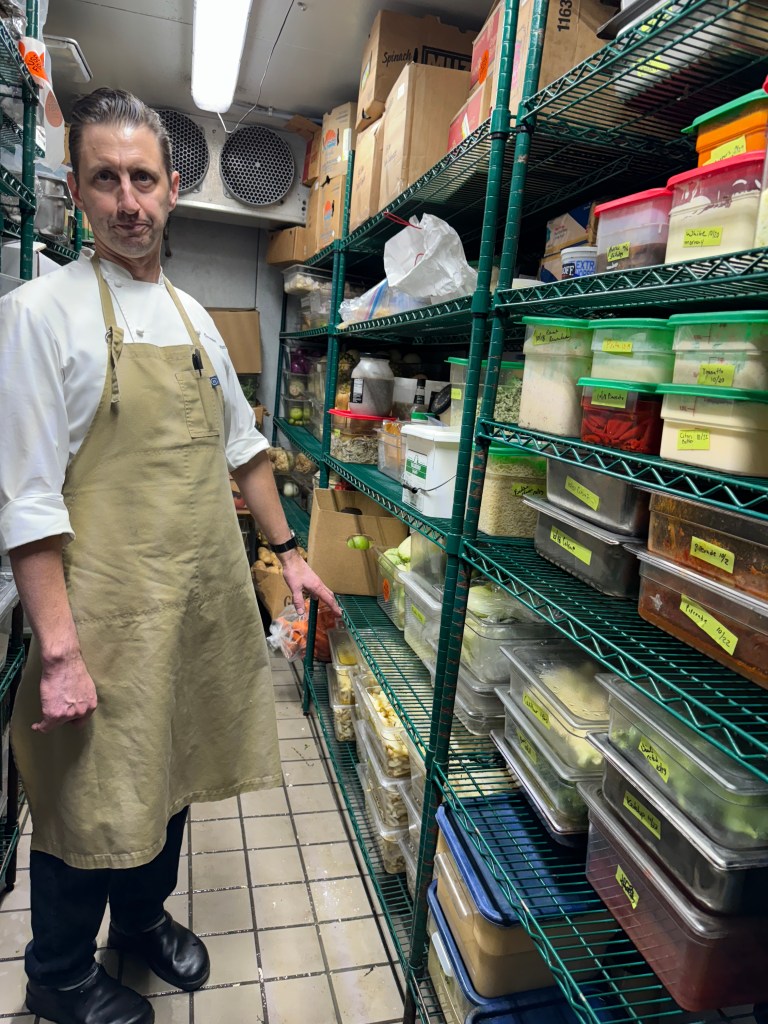


christopher grossman, exec. chef at the chastain, shows off the restaurant’s garden, kitchen and composting/recycling operations
“I came to that realization that salt, fat, acid, heat, I can do all those things… but I can never make something fresher. I can’t replicate that level of freshness.”
So, taste comes first. But sustainable practices are very much integrated into everything The Chastain does. The restaurant practices composting and stringently limits single-use plastics. It also employs a glass recycling service and has adopted compostable materials for disposable to-go cups and containers.
Such meticulous attention to environmental impact has led to a boost in prestige and recognition for The Chastain – which earned a Michelin Green Star as an industry leader in sustainability.
But it comes with a significant price tag. Composting alone costs The Chastain $400 per month, on top of recycling and regular trash pickup. And Grossman recognizes that’s not possible for every restaurant.
“The margins in restaurants are not like a normal business,” he says. “They’ve run on very slim margins, very underpriced labor for a long time. In a way, I feel like the model was broken and we have to reinvent that model.”
Grossman says the way to do that is for restaurants to stop trying to keep menu prices artificially low. That might be difficult for consumers to accept at first, but he says cutting corners is a disservice to both the businesses and the customers they serve.
One strategy The Chastain uses to mitigate the cost of operating at such high standards is to make sure to utilize every bit of the farm-fresh food in its kitchen. For example, bits of fish, meat and vegetables discarded in the process of prepping dishes are used to make stocks for soup and sauces.
“Everything here is 100% from scratch. That gives us a lot of flexibility and different outlets for different things,” Grossman says.
He also points out, you don’t have to have a professional kitchen to reduce your own food waste impact. Grossman recommends crafting a plan to “reinvent” ingredients throughout the week until you’ve used them up. If a roasted chicken is the centerpiece of your dinner plan on Monday, the leftovers can become the protein in a big salad on Wednesday, and then the bones can be used to make a delicious homemade chicken stock.
Any bits of fruits or vegetables that can’t be reinvented, like carrot tops, can go in the compost.
But that’s not the end of The Chastain’s food waste tricks… On a counter at the outer edge of the kitchen is a small buffet. It’s set up twice a day to feed the staff – a delicious perk for employees, made with food from the kitchen that might otherwise go to waste. Grossman also sees it as a valuable training opportunity for aspiring chefs.
“It’s actually a cool thing because it gives all of these young cooks and sous chefs and everybody, they get to contribute,” he says.
“Typically, one guy will do a vegetable, One might do a protein, one might do a starch, he might do a salad.”
He says it gives them an outlet for creativity, a chance to try a new idea… while utilizing something that needed to be utilized.
Final thoughts:
- Some restaurants are combatting food waste by composting and smart kitchen strategies
- Food waste management is rare in the restaurant business because of thin profit margins and scant regulations in many areas
- Strategies employed by The Chastain that you can use in your own home include buying local produce (so it stays good longer) and reinventing your ingredients throughout the week (roast chicken one night becomes chicken salad another day, and stock for a soup later)
Facts & Figures:
- Food is the single largest category of material placed in municipal landfills (24%)
- In the U.S., about a third of the food produced goes uneaten
- Municipal solid waste (MSW) landfills are the third-largest source of methane emissions from human activities in the U.S.
- Methane is responsible for around 30% of the increase in global temperature since the Industrial Revolution
- The greenhouse gas emissions from landfill food waste are equivalent to the annual emissions of 15 coal-fired power plants
- The EPA’s top suggestion for keeping food waste out of landfills is preventing waste in the first place
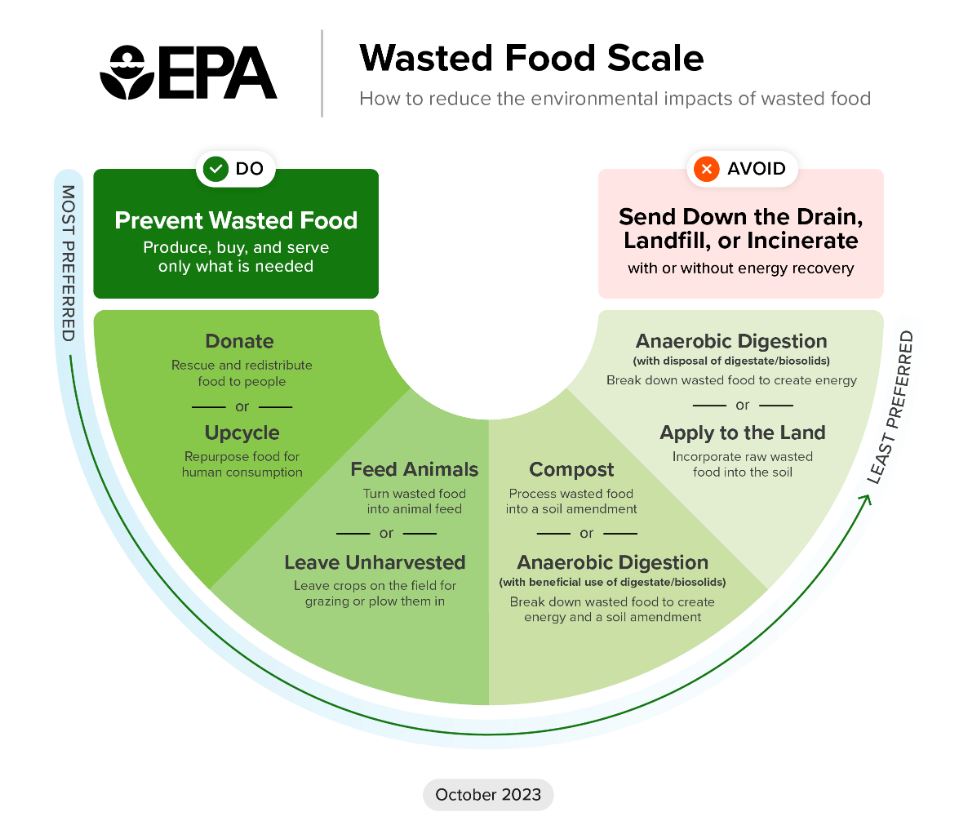

source: epa
- Perhaps the most stunning statistic about the potency of methane compared to carbon dioxide: it has more than 80 times the warming power of CO2 over a 20-year period. It also breaks down in the atmosphere after about a dozen years (as opposed to multiple centuries for CO2). So, rapidly cutting methane this decade could have a huge environmental payoff.

 the green gals podcast
Leave a comment